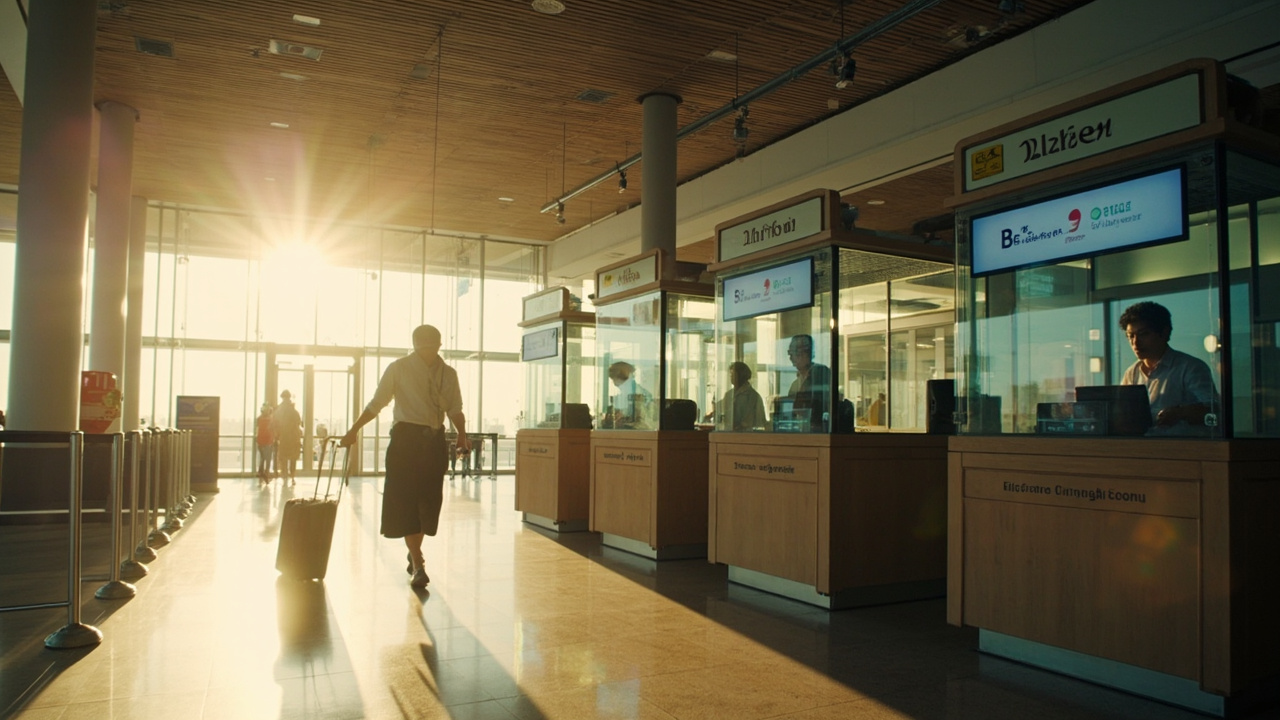
Sihanoukville International Airport (KOS): The Quiet Coast & Islands Gateway for Aussies
KOS (Sihanoukville International) is the small, quiet regional airport that gets Aussies onto the Cambodian coast and across to Koh Rong and Koh Rong Sanloem fastest. Single terminal, short queues, and a tuk-tuk-plus-ferry routing that skips the seven-hour bus from Phnom Penh entirely.

What do Australians need to know about Sihanoukville International Airport (KOS) in 2026?
KOS is Cambodia's small southern-coast airport and the closest gateway to Sihanoukville town, Koh Rong, and Koh Rong Sanloem. Single terminal, limited international routes, VoA available with a typical 10–15 minute queue. For Aussies skipping the seven-hour bus from Phnom Penh, KOS is the practical answer. Tuk-tuk from the terminal to the Sihanoukville ferry pier runs $5–8 USD (~$8–12 AUD); a round-trip island ferry to Koh Rong is $20–25 USD (~$30–38 AUD). Pre-apply for your Cambodia eVisa and submit the e-Arrival Card inside the 7-day window before you fly.
Những điểm chính cần ghi nhớ
- KOS (Sihanoukville International) is a small regional airport with a single terminal and limited international routes. Most arrivals are domestic from Phnom Penh, with a handful of regional flights from Bangkok and other ASEAN hubs.
- If you're an Aussie heading to the Sihanoukville coast or the islands (Koh Rong, Koh Rong Sanloem), KOS is by far the closest airport — flying in saves the seven-hour bus from KTI.
- VoA is available at KOS but quiet — typical queue is 10–15 minutes. The eVisa lane is still faster on principle, and most Aussies pre-apply anyway.
- Onward transfer: tuk-tuk to the Sihanoukville ferry pier runs $5–8 USD (~$8–12 AUD) and takes 15–25 minutes. Round-trip ferry to Koh Rong or Koh Rong Sanloem is $20–25 USD (~$30–38 AUD).
- Bring $200–500 USD cash from Australia for the first few days — the islands have very limited ATM access and most beach bungalows accept USD directly without charging conversion fees.
Why KOS matters for Aussie itineraries in 2026
If your Cambodia trip is built around the southern coast — Sihanoukville beaches, Otres, Ream National Park, or one of the two main islands at Koh Rong and Koh Rong Sanloem — Sihanoukville International (KOS) is the airport you want. It's small, regional, and quiet compared to KTI in Phnom Penh or SAI in Siem Reap, but for Aussies headed to the coast it removes the worst friction in the whole trip: the seven-hour bus from the capital.
KOS isn't a place to linger. Single terminal, a handful of food kiosks, one currency-exchange counter, an ATM row, and a tuk-tuk rank outside arrivals. The international route list is short — mostly domestic links to Phnom Penh and a thin set of regional flights from Bangkok and other ASEAN hubs depending on the season. There are no direct flights from Australia. The realistic Aussie routing is Sydney/Melbourne/Brisbane to a Southeast Asian hub (Bangkok, Singapore, or Kuala Lumpur), then a regional hop into KOS or — more commonly in 2026 — a domestic Cambodia Angkor Air leg from KTI down to KOS once you've cleared Cambodian Immigration in Phnom Penh.
Sort your Cambodia eVisa before you book the regional leg into KOS, and lock in the e-Arrival Card inside the 7-day window before takeoff. The Australia country pillar covers the broader eligibility picture, and our cross-airport airports overview compares KOS to KTI and SAI side-by-side so you can decide which entry point matches your trip shape.
KOS at a glance: small, single terminal, coastal
The honest read on KOS is that it's a regional airport, not a hub. The terminal is roughly the size of a large Australian regional like Coffs Harbour or Hervey Bay. There is one Immigration line for foreigners, one for Cambodian nationals, and a VoA booth tucked to the side that opens for arriving international flights. Bag claim is two carousels, and the walk from the gate to the kerb is short — five minutes if you're not browsing the duty-free.
Getting from KOS to Sihanoukville town and the ferry pier
The standard Aussie routing is straight from the terminal to the Sihanoukville ferry pier. From KOS, the tuk-tuk run to the pier is $5–8 USD (~$8–12 AUD) and takes 15–25 minutes depending on whether the driver loops through Sihanoukville town centre first. If you're staying in Sihanoukville itself rather than crossing to the islands, the same tuk-tuk into town costs the same and takes 25–35 minutes to reach the Otres and Serendipity beach areas where most Aussie accommodation sits.
Câu hỏi thường gặp
Which Cambodian airport do I fly into for Koh Rong or Koh Rong Sanloem?
Sihanoukville International (KOS). It is the closest airport to the Sihanoukville ferry pier where the boats depart for Koh Rong and Koh Rong Sanloem. KOS is about 18 km north of Sihanoukville town and 15–25 minutes by tuk-tuk from the ferry pier. Flying into KOS is by far the fastest routing — the alternative is landing at KTI Phnom Penh and taking a seven-hour bus down to the coast, which most Aussies regret on a tight schedule.
Can I get a visa on arrival at KOS Sihanoukville?
Yes — VoA is available at KOS and the queue is typically 10–15 minutes, much shorter than at KTI. You will need a passport-style photo, two USD bills in small denominations totalling the VoA fee, and a printed onward ticket. That said, the eVisa lane is still smoother on principle because the paperwork is already approved. Most Aussies pre-apply for the Cambodia eVisa and use the eVisa lane regardless of which airport they land at.
How much does the tuk-tuk from KOS to the ferry pier cost?
$5–8 USD (~$8–12 AUD) is the fair tuk-tuk fare from KOS arrivals to the Sihanoukville ferry pier. The drive takes 15–25 minutes depending on whether the driver loops through Sihanoukville town. Pay in USD where you can — drivers prefer it. A fixed-rate airport taxi is the air-conditioned alternative at $12–15 USD (~$18–23 AUD), which is worth it during the hot months between November and April.
How much is the ferry to Koh Rong from Sihanoukville?
Round-trip ferry tickets to Koh Rong or Koh Rong Sanloem run $20–25 USD (~$30–38 AUD) at the pier kiosk. Speed-Ferry Cambodia and Buva Sea Cambodia are the two main operators; both run a daily schedule with first ferry around 8 am and last around 5 pm. Tickets are usually open-return, so you can decide on the day which boat back you want. Pay in USD at the kiosk; AUD is not accepted.
Are there ATMs at KOS airport?
Yes — Wing, ABA, and Acleda Bank machines are present in arrivals and dispense both USD and Cambodian Riel (KHR). USD machines are the better choice for the tuk-tuk, ferry, and first day on the islands. The currency-exchange counter charges a worse rate than the ATMs. Pull $50–100 USD in small bills before you leave the airport — small denominations are easier to break for tuk-tuks and food kiosks on the coast.
Is KOS open 24 hours? What if my flight lands late?
KOS is open through scheduled flight operations but is not a 24-hour airport in the way KTI is. Most international and domestic flights land between 8 am and 9 pm. If your flight lands after 8 pm, the tuk-tuk rank thins out quickly and the fixed-rate taxi desk is the more reliable option. Book a hotel transfer ahead of time if your scheduled arrival is in the late evening — driver availability is genuinely thinner here than at KTI or SAI.
Nguồn
Did this guide help you?
Từ blog của chúng tôi

Lập kế hoạch chuyến đi
Những Điều Cần Biết Trước Khi Đến Campuchia: Danh Sách Kiểm Tra Cho Người Mới Đến là Người Mỹ
Chuyến đi đầu tiên đến Campuchia? Dưới đây là danh sách kiểm tra thực tế cho người mới đến là người Mỹ — thị thực, đặc điểm sử dụng đô la Mỹ, thực trạng an toàn, vaccine, quy định trang phục khi tham quan đền, và cảnh thực tế khi đến sân bay mới vào năm 2026.

Kết Hợp Quốc Gia
Thái Lan đến Campuchia năm 2026: Tại sao Bạn Phải Bay (Cửa khẩu đường bộ đóng cửa) dành cho người Mỹ
Tất cả bảy cửa khẩu đường bộ giữa Thái Lan và Campuchia đã đóng cửa kể từ tháng 6 năm 2025, vì vậy trong năm 2026, cách duy nhất để người Mỹ từ Thái Lan vào Campuchia là bay. Dưới đây là cách hoạt động của các tuyến Bangkok-Siem Reap và Bangkok-Phnom Penh, thị thực điện tử Campuchia bạn cần trước khi lên máy bay, và lý do kế hoạch đi bộ qua Poipet cũ không còn tồn tại.

Lập kế hoạch chuyến đi
Cách Di Chuyển từ Phnom Penh đến Siem Reap: Xe Khách, Máy Bay hoặc Phà dành cho Người Mỹ
Ba cách để di chuyển 195 dặm giữa thủ đô Campuchia và Angkor Wat: xe khách chạy nhanh $15, chuyến bay 45 phút, hoặc phà đường sông chậm. Dưới đây là chi phí thực tế, thời gian di chuyển của từng phương tiện dành cho du khách Mỹ, và phương án nào phù hợp với chuyến đi của bạn.